


Setting Up the SXJ-10 Vacuum Planetary Mixer for Silicone Sealant Development and Production
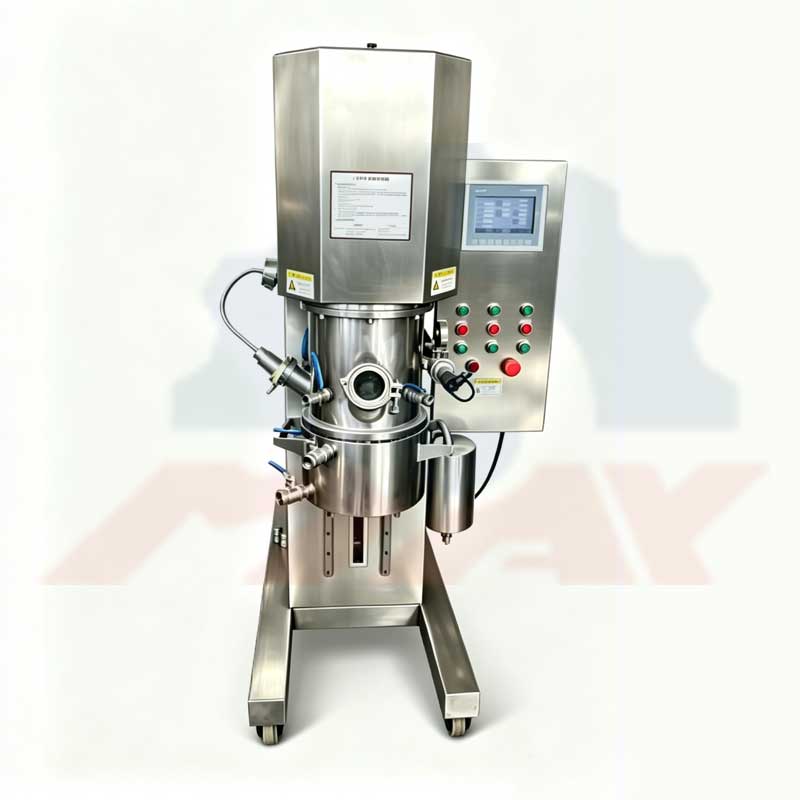
Establishing a reliable process for silicone sealant development requires careful consideration of equipment selection, process parameters, and operational procedures. This guide outlines the key steps for utilizing the SXJ-10 Vacuum Planetary Mixer for high-quality silicone sealant formulation and pilot production, with integration into a complete production line .
Step 1: Material Preparation and Formulation
The first step in successful silicone sealant production is proper material preparation. Silicone sealant formulations typically include:
Base polymer: Polydimethylsiloxane (PDMS) or other silicone polymers
Filler: Fumed silica, calcium carbonate, or other reinforcing fillers
Crosslinkers: Alkoxy silanes, acetoxy silanes, or other curing agents
Catalysts: Tin or titanium compounds for condensation cure
Additives: Adhesion promoters, pigments, UV stabilizers, or thixotropic agents
All materials should be accurately weighed and pre-conditioned to remove moisture that could affect cure properties. For fumed silica, controlled addition during mixing prevents dust and ensures uniform dispersion. For moisture-sensitive systems, all materials should be stored in sealed containers under dry conditions .
Step 2: Planetary Mixing and Dispersion
The SXJ-10's combination of low-speed kneading and high-speed dispersion is ideal for silicone sealant preparation. The standard process involves:
Initial charging: Add polymer base and plasticizers to the mixing vessel
Filler addition: Introduce fillers and additives under vacuum
Low-speed mixing: Operate the planetary blades at 20-43 rpm for initial incorporation
High-speed dispersion: Activate the 1.5KW disperser at 1,500-2,980 rpm for 30-90 minutes
Final mixing: Continue low-speed mixing under vacuum for deaeration
The PTFE scraper ensures continuous wall cleaning, preventing material buildup that could affect heat transfer and mixing uniformity . The entire process should be performed under -0.09 MPa vacuum to remove entrapped air and prevent moisture contamination .
Step 3: Process Optimization and Quality Control
Achieving consistent sealant quality requires careful parameter control. The SXJ-10's parameters should be optimized for each formulation:
Quality control should include viscosity measurements (using a rheometer), filler dispersion assessment, and visual inspection for agglomerates and bubbles. The SXJ-10's 10L capacity allows for multiple test samples, enabling comprehensive characterization without excessive material consumption .
Step 4: Discharge and Downstream Processing
After mixing, the sealant must be discharged for packaging. The SXJ-10 offers two discharge options:
Direct discharge: Remove the mixing vessel and transfer sealant manually
Optional hydraulic presser: Use the extrusion system for controlled, contamination-free discharge
The presser attachment is particularly valuable for high-viscosity sealants, as it applies uniform pressure to extrude the material without introducing air bubbles . The discharged sealant should be transferred to cartridges, sausages, or other packaging within a controlled timeframe to prevent moisture absorption.
For larger production volumes, the SXJ-10 serves as the R&D and pilot-scale unit that informs the process parameters for industrial-scale planetary mixers (50L-2000L) and fully automatic filling lines . This seamless scale-up path ensures that formulations developed on the SXJ-10 can be reproduced reliably in mass production.
Step 5: Cleaning and Maintenance
Proper cleaning is essential for maintaining the SXJ-10's performance. The electric lifting system provides easy access to the mixing vessel, disperser, and blades . For silicone sealant cleaning, protocols should include:
Solvent rinse: Use appropriate solvent (e.g., white spirit, isopropanol) to dissolve residual sealant
Mechanical cleaning: Scrape and wipe all contact surfaces
Inspection: Check PTFE scraper wear and blade clearances
Seal maintenance: Verify mechanical seal integrity for vacuum performance
| Maintenance Task | Frequency | Importance |
|---|---|---|
| PTFE Scraper Inspection | Weekly | Prevents wall buildup and ensures mixing efficiency |
| Mechanical Seal Check | Monthly | Maintains vacuum integrity |
| Safety Interlock Test | Weekly | Ensures operator protection |
| Lifting System Operation | Weekly | Verifies smooth and safe lifting |
| Vessel Cleaning | Per batch | Prevents cross-contamination |
| Bearing Lubrication | Quarterly | Extends equipment life |





