


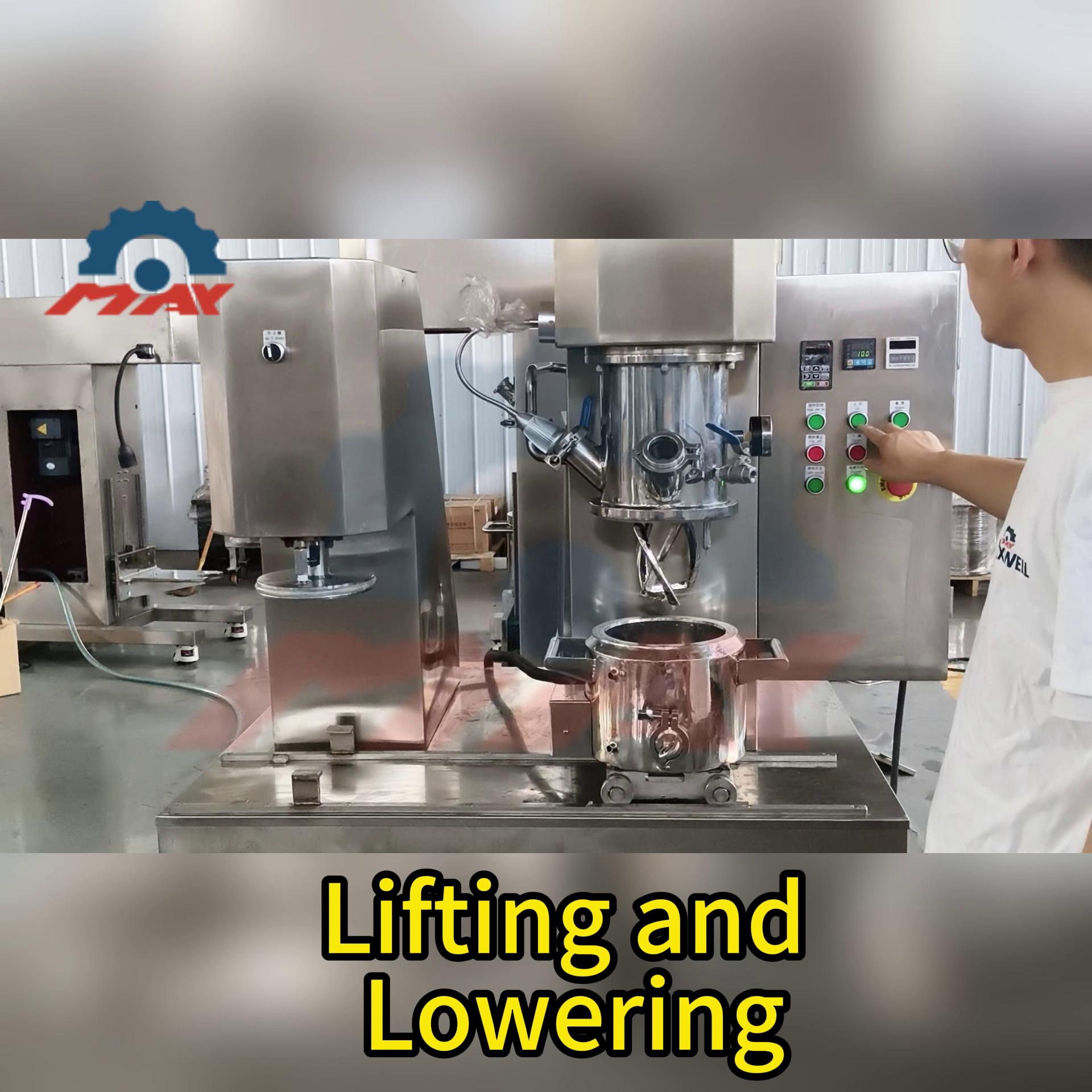
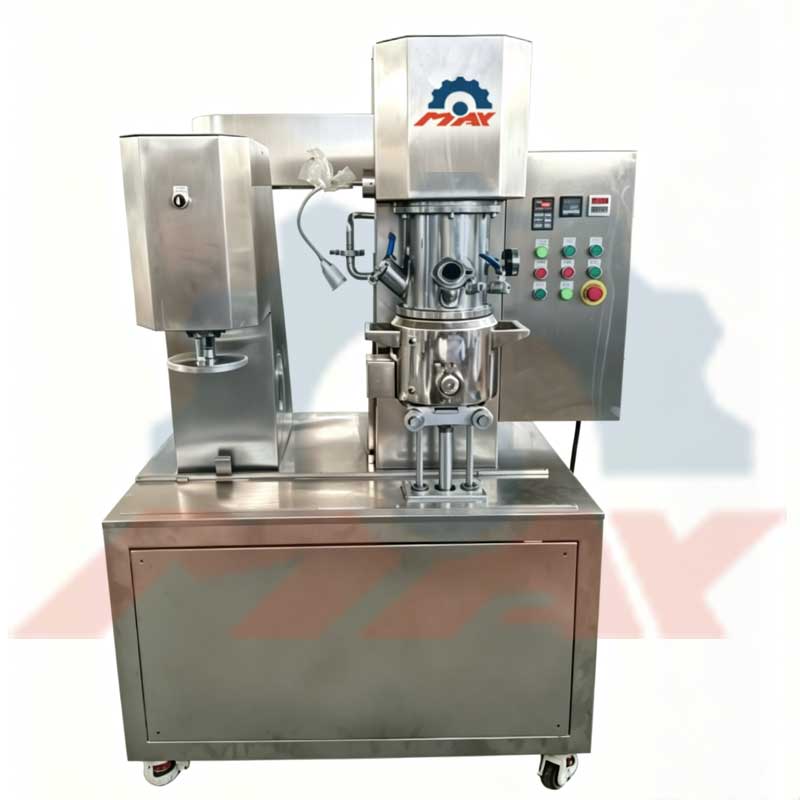
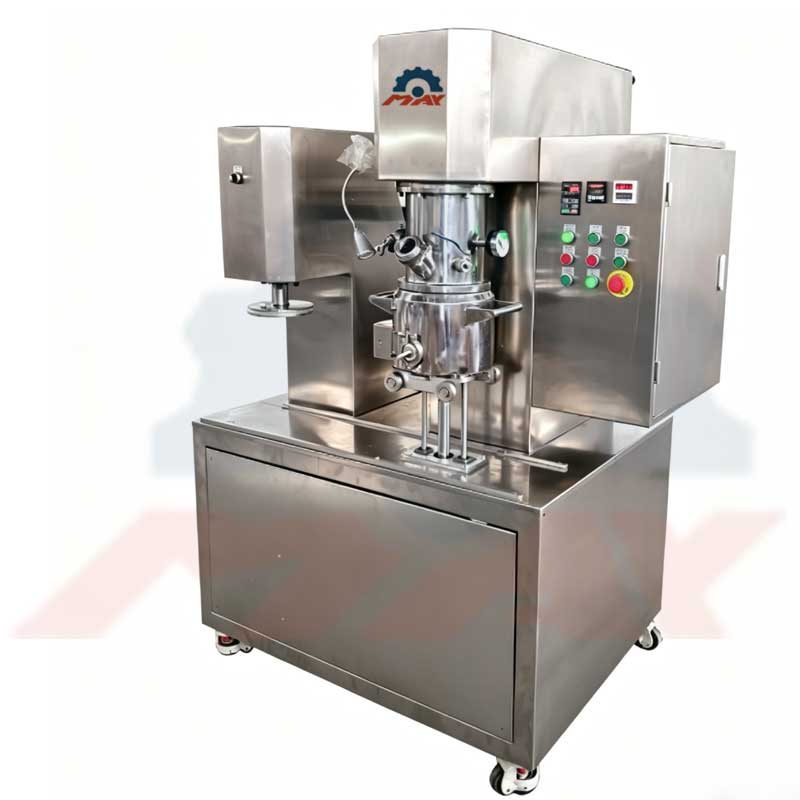

A compact laboratory double planetary mixer built for high-viscosity materials: it kneads and disperses under vacuum, then pushes the finished batch out through an integrated presser — no hand-scooping, no dead corners, no unmixed zones.
What is it? The MAXWELL 2L planetary vacuum mixer with presser (model SXJ-2) is a laboratory-grade mixing system for universities, research institutes and factory labs. It combines a low-speed planetary agitator (0–51 rpm revolution, 0–112 rpm self-rotation) with a high-speed disperser (up to 2980 rpm) inside a sealed, vacuum-capable 316L/304 stainless vessel (3L design / 2L working volume, φ180×120 mm, vacuum to -0.09 MPa), and adds a presser on a sliding rail that discharges the mixed high-viscosity mass — integrating mixing and discharging into one workflow. Typical materials: adhesives, silicone sealant, lithium battery slurry, pastes and gels.
Why a Presser on a Lab Mixer? The Mix-and-Discharge Workflow
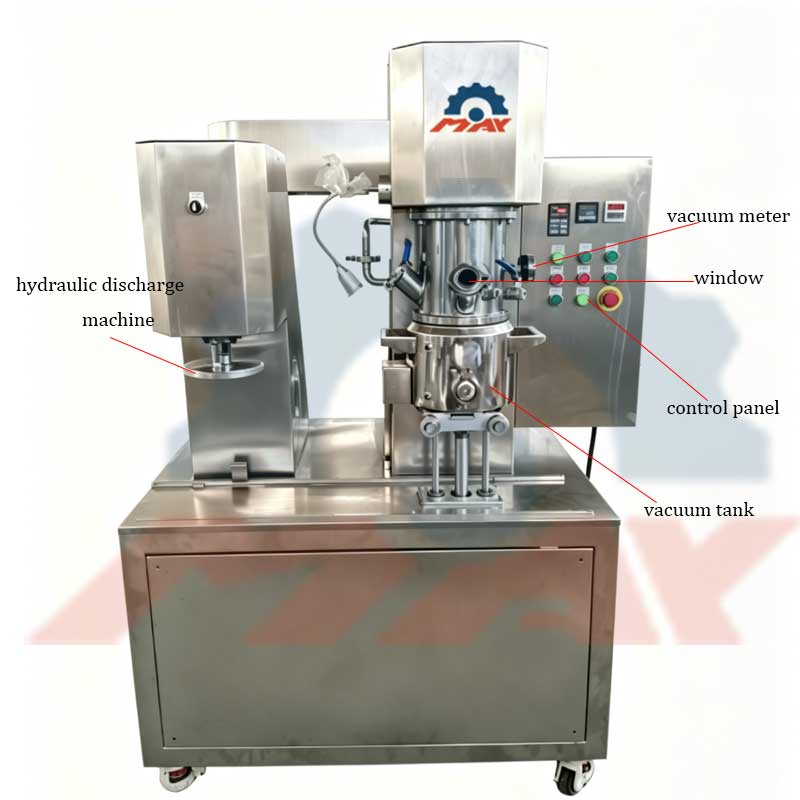
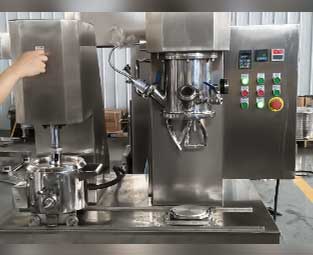
Most laboratory mixers stop at the end of the mixing cycle — and leave the operator to dig a 2-litre block of adhesive or sealant out of the vessel with a spatula. On this machine, that step is engineered away. The presser (press machine) is the dedicated supporting equipment of the planetary mixer: its function is to discharge or separate the high-viscosity mass produced by the mixer. For laboratory planetary mixing machines, the press equipment can be integrated with mixing and pressing of the material, working together with a sliding rail so the vessel travels between stations without being carried by hand.
Manual scooping vs. presser discharge
| Aspect | Lab mixer without presser | 2L planetary vacuum mixer with presser |
|---|---|---|
| Discharge method | Operator scoops material out of the vessel by hand | Press machine discharges or separates the high-viscosity mass; mixing and pressing integrated |
| Material waste | High — thick material clings to vessel walls and tools | Low — batch is pressed out of the vessel |
| Vessel handling | Vessel carried manually between stations | Sliding rail moves the vessel between mixing and pressing positions |
| Operator exposure | Direct contact with adhesives, sealants, chemical pastes | Closed, mechanized transfer of the finished mass |
| Batch-to-batch consistency | Depends on operator technique | Repeatable machine-controlled workflow |
Working Principle: Planetary Motion in a Sealed, Vacuum-Capable Vessel
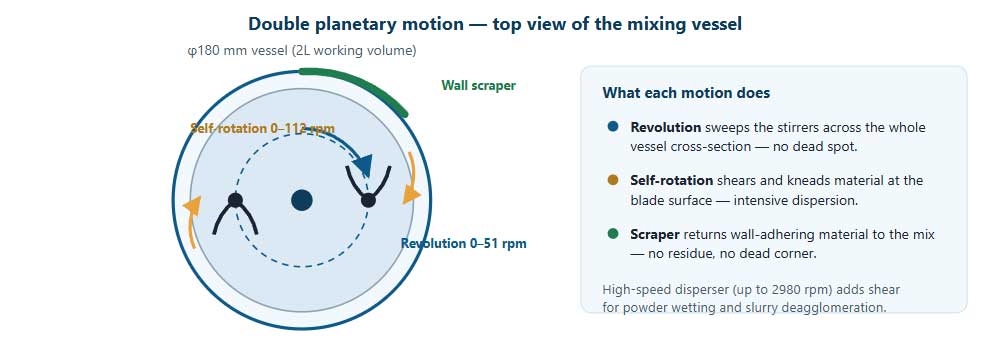
The planetary power mixer is a high-efficiency stirring device with no dead spot. Inside the vessel, two or three stirrers — plus one or two auto scrapers — revolve around the axle of the vessel while each stirrer simultaneously rotates around its own axis at a different speed. This compound movement produces strong shearing and kneading forces on the material from every direction, so solid-liquid and liquid-liquid phases disperse, dissolve and homogenize quickly and evenly.
The scraper mounted on the planetary frame revolves with it and clings to the container wall, continuously scraping adhering material back into the mix — the key to eliminating dead corners and residue. Meanwhile, the vessel's special sealing structure supports both pressurized and vacuumized mixing with excellent exhaust and bubble-removal performance, which matters wherever entrapped air would degrade density or stability (battery slurries, electronic adhesives, high-end pastes).What each motion does
Beyond the motion itself, the machine is designed around laboratory ergonomics: the vessel cover lifts and lowers electrically, the vessel itself is movable, and the stirrers and scraper rise with the beam and fully detach from the vessel body for easy cleaning. The tank can be jacketed for heating or cooling by circulating oil or water, with temperature inspection supported.
Machine Structure & Key Components
Mixing-head options — configured to your material
| Component | Function | Best suited for |
|---|---|---|
| Double twist mixing head | Low-speed kneading and folding under strong torque | Very high-viscosity pastes, silicone, adhesives, rubber compounds |
| Double-layer high-speed dispersing head | High shear at up to 2980 rpm | Powder wetting, pigment dispersion, battery slurry deagglomeration |
| Emulsifying head (homogenizer) | Intensive shear for fine emulsions | Creams, gels, liquid-liquid systems |
| Wall scraper | Continuously scrapes vessel wall and bottom | All materials — eliminates dead corners and residue |
| Blade / claw / frame impellers | Alternative low-speed agitation geometries | Selected by viscosity and specific gravity of the material |
Mixing-head combinations are tailored to each process: twist impeller blades, dispersing discs, homogenizers and scrapers are all selectable, and high-speed/high-speed, high-speed/low-speed and low-speed/low-speed combinations each deliver a distinct mixing effect.
2L Planetary Vacuum Mixer — Technical Specifications
| Parameter | SXJ-2 (2L) |
|---|---|
| Model | SXJ-2 |
| Design volume | 3 L |
| Working volume | 2 L |
| Tank inner size | φ180 × 120 mm |
| Rotary (planetary) power | 0.75 kW |
| Revolution speed | 0–51 rpm, adjustable |
| Self-rotary speed | 0–112 rpm, adjustable |
| Disperser power | 0.75 kW |
| Disperser speed | 0–2980 rpm, adjustable |
| Vacuum capability | Sealed vessel for vacuumized (and pressurized) mixing with exhaust / bubble removal — vacuum level down to -0.09 MPa |
| Material of construction | SUS304 / SUS316L stainless steel (customizable; special spraying materials optional) |
| Lifting method | Electric lifting |
| Vessel | Jacketed option (oil or water heating / cooling); changeable precision-machined inner tank |
| Presser | Integrated press machine with sliding rail — mixing and pressing in one system |
| Control | Digital time relay for speed & mixing-time setting; integrated control cabinet with power, voltage, current and frequency-conversion controls; emergency stop button |
| Overall dimensions | 800 × 580 × 1200 mm |
| Place of origin | Wuxi, Jiangsu, China |
| Packing | Wooden case / stretch wrap |
| Delivery time | 30–40 days |
Operation & Control: Built for Lab Staff, Not Just Engineers
Electric lifting tank. The electric lifting function lets materials be stirred under closed conditions; the pot is easy to clean and easy to operate.
Configurable agitation. Spiral stirrer, scraper and dispersion plate types can all be configured to customer requirements.
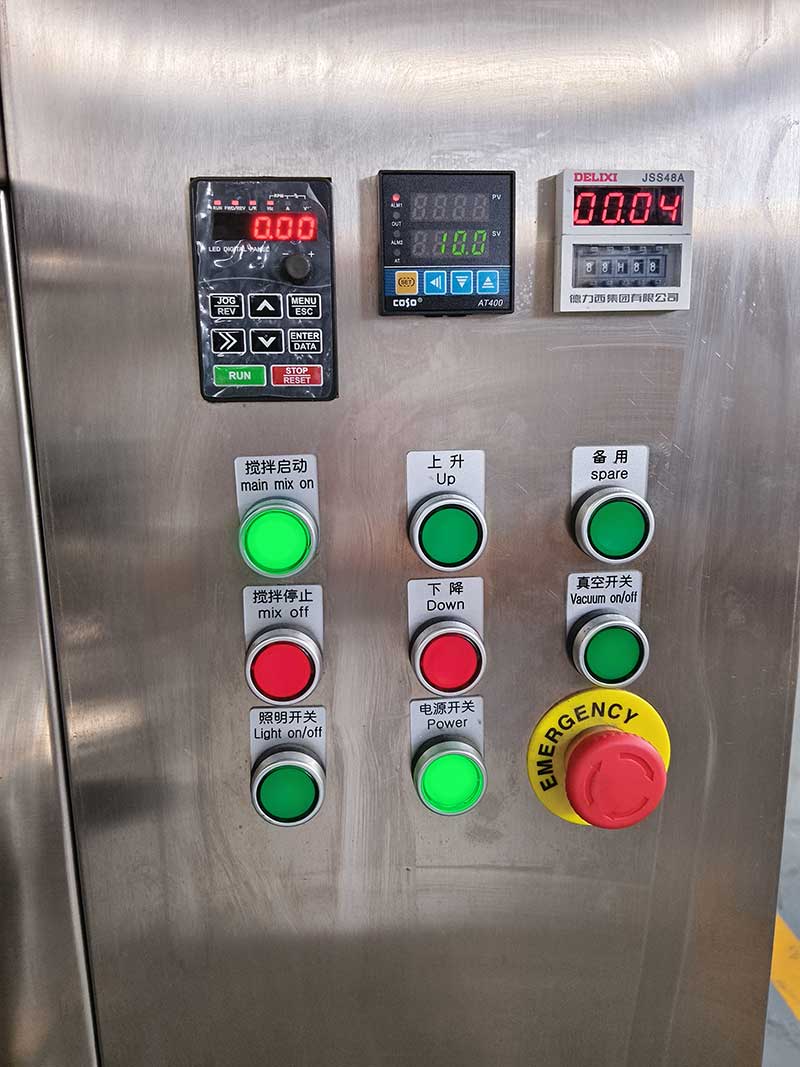
Centralized control. A digital time relay adjusts mixer speed and working time to match each product's process. The electrical control cabinet integrates power on/off, voltage, current and frequency-conversion speed control, with mixing-time setting centralized in one place — the operating status is clear at a glance.
Safety first. Emergency stop button as standard; explosion-proof builds available for solvent-bearing or flammable formulations.
Applications: What Labs Mix on This Machine
The machine is especially suitable for the dispersing and mixing of solid-liquid and liquid-liquid phases, and — because of its super-strong output torque — for high-viscosity products. Typical materials and their mixing challenges:
| Industry / Lab | Typical materials | Why this machine fits |
|---|---|---|
| New energy research | Lithium battery slurry, other battery pastes | Vacuum mixing removes entrapped air; high-speed disperser breaks agglomerates; strong torque handles thick slurries |
| Adhesives & sealants | Silicone sealant, structural adhesives, potting compounds | High-viscosity kneading plus scraper keeps the whole batch in motion; presser discharges the finished mass cleanly |
| Chemicals & coatings | Resins, inks, putty, abrasives, wax products | Solid-liquid dispersion with no dead corners; jacketed heating/cooling for temperature-sensitive reactions |
| Cosmetics & pharma R&D | Creams, gels, ointments, pastes | Optional homogenizer head for fine emulsions; sealed vessel protects product integrity |
| Universities & institutes | Formulation studies, small-batch trials | 2L working volume conserves expensive raw materials; repeatable time/speed programs |
Customization Options
Explosion-proof configuration for flammable or solvent-based materials
Closed-type build for contained processing
Heating type with jacketed vessel (oil or water circuit)
PLC intelligent control type
Contact parts in SS304, SS316L or special spraying materials
Alternative agitator geometries: blade, twist, claw, frame — matched to viscosity and specific gravity
From 2L to 2000L: One Platform, One Scale-Up Path
Formulations proven on the 2L lab unit can move up the same SXJ planetary mixer family — identical working principle, progressively stronger drives. The table below lists the standard SXJ series; contact MAXWELL to size a pilot or production machine around your batch.
| Model | Design volume (L) | Working volume (L) | Tank inner size (mm) | Rotary power (kW) | Revolution (rpm) | Self-rotary (rpm) | Disperser power (kW) | Disperser speed (rpm) | Lifting | Dimensions (mm) |
|---|---|---|---|---|---|---|---|---|---|---|
| SXJ-2 (this page) | 3 | 2 | φ180×120 | 0.75 | 0–51 | 0–112 | 0.75 | 0–2980 | Electric | 800×580×1200 |
| SXJ-5 | 7.4 | 5 | φ250×150 | 1.1 | 0–51 | 0–112 | 1.1 | 0–2980 | Electric | 1200×700×1800 |
| SXJ-10 | 14 | 10 | φ300×200 | 1.5 | 0–48 | 0–100 | 1.5 | 0–2980 | Electric | 1300×800×1800 |
| SXJ-15 | 24 | 15 | φ350×210 | 2.2 | 0–43 | 0–99 | 2.2 | 0–2980 | Electric | 1500×800×1900 |
| SXJ-30 | 43 | 30 | φ400×350 | 3 | 0–42 | 0–97 | 3 | 0–2980 | Electric | 1620×900×1910 |
| SXJ-50 | 68 | 48 | φ500×350 | 4 | 0–39 | 0–85 | 4 | 0–2100 | Electric | on request |
| SXJ-60 | 90 | 60 | φ550×380 | 5.5 | 0–37 | 0–75 | 5.5 | 0–2100 | Hydraulic | 1800×1100×2450 |
| SXJ-100 | 149 | 100 | φ650×450 | 7.5 | 0–37 | 0–75 | 11 | 0–2100 | Hydraulic | 2200×1300×2500 |
| SXJ-200 | 268 | 200 | φ750×600 | 15 | 0–30 | 0–61 | 22 | 0–1450 | Hydraulic | 2400×1600×2800 |
| SXJ-300 | 376 | 300 | φ850×650 | 22 | 0–28 | 0–56 | 30 | 0–1450 | Hydraulic | 3300×1300×3400 |
| SXJ-500 | 650 | 500 | φ1000×830 | 37 | 0–24 | 0–48 | 45 | 0–1450 | Hydraulic | 3700×1500×3500 |
| SXJ-1000 | 1327 | 1000 | φ1300×1000 | 45 | 0–20 | 0–36 | 55 | 0–1450 | Hydraulic | 4200×1800×3780 |
| SXJ-2000 | 2300 | 2000 | φ1500×1300 | 75 | 0–13 | 0–35 | 90 | 0–1450 | Hydraulic | 4500×2010×4000 |
SXJ planetary mixer series data. 2L–50L models use electric lifting; 60L and above use hydraulic lifting. Related lab units: 5L laboratory vacuum planetary mixer with extruder · 10L lab vacuum double planetary mixer
Machine in Operation — Video
Frequently Asked Questions
What does the presser on a 2L planetary vacuum mixer do?
The presser is a screw press that works alongside the planetary mixer as its supporting equipment: it discharges or separates the high-viscosity mass produced in the vessel. On the laboratory machine, mixing and pressing are integrated — with the sliding rail, one operator completes the whole mix-and-discharge workflow at a single station.
What viscosity range can this machine handle?
The double planetary drive delivers super-strong output torque, making the machine well suited to high-viscosity products such as adhesives, silicone and lithium battery slurry, as well as general solid-liquid and liquid-liquid dispersing, mixing and dissolving duties. Agitator geometry (blade, twist, claw, frame) is selected to match the viscosity and specific gravity of your material.
Can the vessel be heated or cooled?
Yes — the vessel can be jacketed for heating or cooling by circulating oil or water, and the machine supports temperature inspection. Heating-type and closed-type configurations are available as options.
What mixing heads are available?
Standard configuration combines a double twist mixing head with a double-layer high-speed dispersing head. A wall scraper, an emulsifying (homogenizer) head, twist impeller blades and dispersing discs are all optional, and combinations are tailored to each customer's process.
How easy is it to clean between batches?
The stirrers and scraper rise with the beam and fully detach from the vessel body; the changeable inner tank is precision-machined for easy cleaning; and the movable vessel can be taken directly to a wash station.
Can I scale up from this 2L lab mixer later?
Yes. The same SXJ platform runs from 2L to 2000L working volume (see the series table above), so a formulation proven at lab scale can move to 5L/10L/15L pilot machines and on to 500L–2000L production units using the same working principle and mixing-head options.
Get the 2L Planetary Vacuum Mixer Spec Sheet & Quote
Tell us your material, viscosity range and batch size — MAXWELL engineers will confirm the right mixing-head combination, vessel material and options (explosion-proof, heating, PLC) for your lab.
Get a Free Quote





