


How Does the SXJ-10 Vacuum Planetary Mixer Handle Silicone Sealant Production?
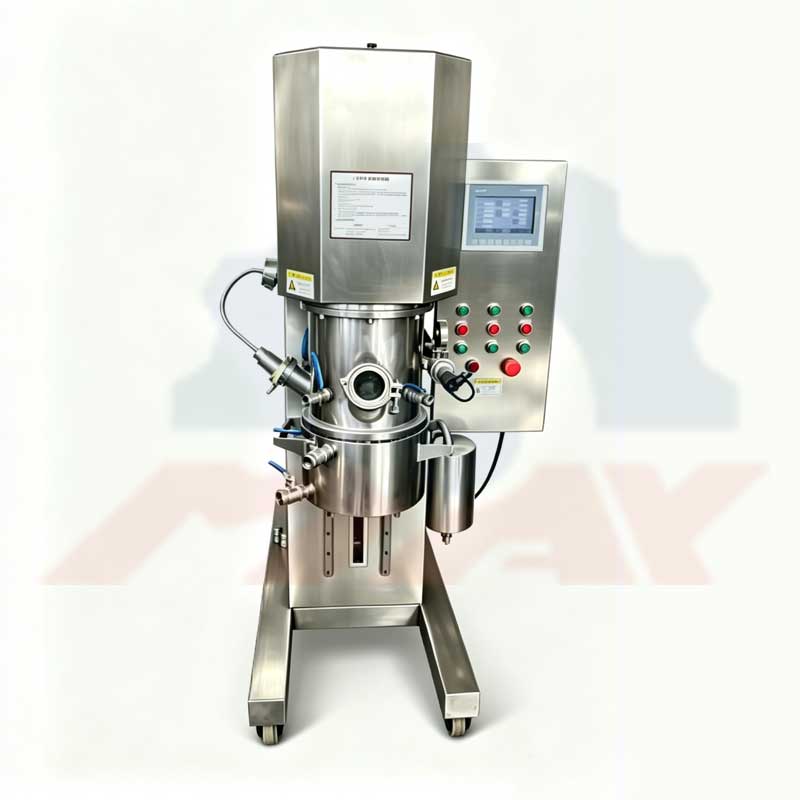
Q: Why is a Vacuum Planetary Mixer preferred for silicone sealant production?
A: The Vacuum Planetary Mixer is the industry standard for silicone sealant production because it addresses the three critical requirements: uniform dispersion of fillers, complete deaeration, and high-viscosity handling . Silicone sealants contain high loadings of fillers (silica, calcium carbonate), crosslinkers, and catalysts that must be thoroughly mixed to achieve consistent rheology and curing properties . The planetary motion combined with high-speed dispersion achieves this level of uniformity that standard mixers cannot replicate . As a vacuum double planetary mixer, it ensures bubble-free products with reliable sealing performance.
Q: How does the planetary motion benefit silicone sealant mixing?
A: The planetary motion creates a unique mixing action where two low-speed blades rotate on their own axes while orbiting around the central axis of the mixing vessel . This complex movement generates multiple flow patterns that continuously renew shear zones throughout the material . For silicone sealants, this ensures that:
Fillers are uniformly distributed to maintain consistent mechanical properties
Crosslinkers and catalysts are thoroughly dispersed for reliable curing
Pigments and additives are evenly incorporated without agglomerates
No dead zones exist where unmixed material could cause batch inconsistency
Q: What role does the high-speed disperser play in sealant production?
A: The high-speed disperser, operating at up to 2,980 rpm, generates intense shear forces that break down agglomerates and ensure thorough powder-liquid wetting . This is particularly important for fumed silica dispersion, which tends to form agglomerates that can lead to poor rheology and reduced sealant performance . The disperser also accelerates the incorporation of fillers and additives, reducing batch cycle times and improving production efficiency .
Q: Why is vacuum degassing critical for silicone sealant?
A: Vacuum degassing removes entrapped air from the sealant, which is essential for producing bubble-free products that provide reliable sealing performance. Air bubbles in sealants create voids that weaken adhesion and compromise barrier properties . The -0.09 MPa vacuum level ensures complete deaeration while also facilitating material transfer and preventing moisture ingress that could prematurely cure the sealant .
Q: What viscosity range can the SXJ-10 handle?
A: The SXJ-10 Vacuum Planetary Mixer is designed to handle materials with viscosities from 5,000 to 10,000,000 cps . This wide range makes it suitable for various silicone sealant formulations, from low-viscosity self-leveling sealants to high-viscosity paste sealants for vertical applications. The mixer's robust gearbox and motor deliver consistent torque even under heavy loads, ensuring reliable processing regardless of viscosity variations .
| Silicone Sealant Application | Key Mixing Requirement | SXJ-10 Benefit |
|---|---|---|
| High-Strength Sealant | Uniform filler dispersion | Planetary motion ensures complete mixing |
| Self-Leveling Sealant | Low-viscosity handling | 10,000,000 cps capability |
| Fumed Silica Dispersion | Agglomerate breakdown | 2,980 rpm disperser speed |
| Color-Matched Sealant | Uniform pigment distribution | Combined low/high-speed mixing |
| All Sealants | Bubble-free product | -0.09 MPa vacuum degassing |





