


Semi-Automatic vs. Automatic Filling Machines: Which Is Right for Your Business?
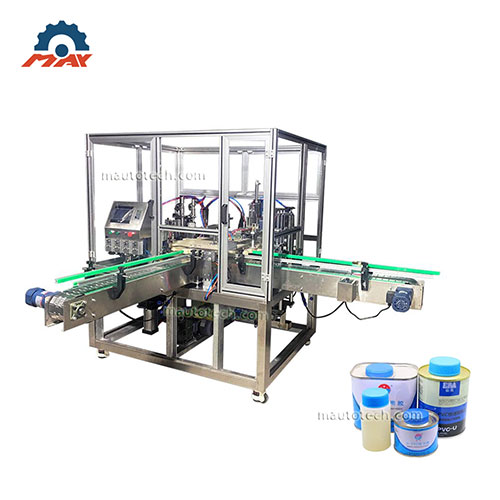
One of the most common questions manufacturers face when upgrading their packaging line is whether to invest in a semi-automatic or a fully automatic filling machine. Both have their place, and the right choice depends on your production volume, budget, and operational flexibility.
Understanding the Difference
A semi-automatic filling machine requires some manual intervention, typically in placing and removing containers, while the filling process itself is automated. In contrast, a fully automatic machine integrates with conveyors and other equipment to handle the entire process—from unscrambling bottles to capping and labeling—without manual input.
The MAX-DRUM-MSGF+YJ is a prime example of a semi-automatic machine. Operators place a container under the filling head, the machine automatically fills it to the preset weight or volume, and the operator then moves the filled container to the next stage. This design offers several advantages:
Lower Initial Investment: Semi-automatic machines are generally more affordable than their fully automatic counterparts.
Greater Flexibility: They can handle a wider range of container sizes and shapes with minimal changeover time.
Easier Maintenance: With fewer moving parts and simpler controls, they are often easier to maintain and troubleshoot.
Ideal for Small-to-Medium Batches: If your production runs are measured in dozens or hundreds rather than thousands, semi-automatic equipment provides excellent value.
When to Choose Fully Automatic
| Feature | Semi-Automatic | Fully Automatic |
|---|---|---|
| Production Volume | Low to medium (hundreds per day) | High (thousands per day) |
| Container Handling | Manual placement/removal | Fully integrated conveyor system |
| Labor Requirement | 1-2 operators | Minimal operator oversight |
| Flexibility | High (easy changeover) | Lower (changeover more complex) |
| Investment Level | Moderate | Significant |
| Best For | Small-to-medium businesses, diverse product lines | Large-scale, single-product production |
Hybrid Solutions
For many growing businesses, a semi-automatic filling machine offers the perfect balance. It provides the precision and consistency of automation while maintaining the flexibility to handle multiple product types and container sizes. This is particularly valuable for contract packagers or manufacturers with diverse product portfolios.
Making the Decision
Consider your current production needs and future growth plans. If you're filling 5-15kg drums of grease or sealant and running 240-360 units per hour, a high-quality semi-automatic machine like the MAX-DRUM-MSGF+YJ may be the ideal solution. Its 200L barrel presser, specifically designed for externally ribbed drums, solves a common challenge in high-viscosity filling: consistent material feed from standard storage containers.
For those with simpler liquid products, a semi automatic bottle filler or manual bottling equipment might suffice. However, for viscous pastes and adhesives, a purpose-built machine with a presser system is indispensable for achieving consistent fill weights and minimizing waste.





